Positive School Environment: Key to a Fresh Start
Apr 29, 2026
Discover why a positive school environment matters for a fresh start. Boost confidence, learning, and well-being with these helpful tips.
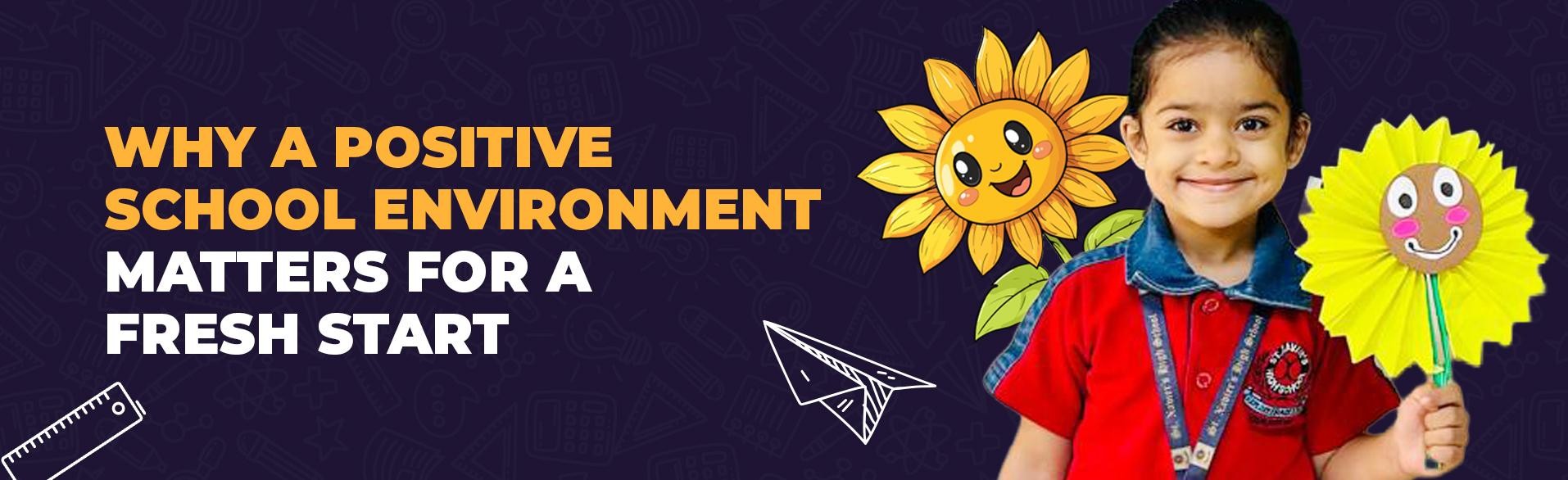
Walk a young child into a positive school environment on their first morning of a new session and watch what happens to their body language within twenty minutes.
A five-year-old started at a new school last April. New campus, new teacher, new classmates. The parents expected tears. What they watched through the classroom window instead was their son leaning across a table to help the child next to him find the right building block. By the third day, he was arriving ten minutes early and asking to stay back in the soft play zones after dismissal.
Nothing about the child had changed overnight. The environment he walked into had simply made it safe to be curious, helpful, and genuinely present from the very first week.
The Real Importance of School Environment on How Children Learn
The importance of School environment sits considerably deeper than wall displays, modern classroom furniture, and well-maintained early-years facilities. It asks whether a young child feels psychologically safe enough to attempt something they might get wrong in front of other people.
That specific condition is the one that determines whether early learning actually happens. A child in a classroom where mistakes are met with frustration, or where they are lost in a massive crowd of students, allocates a significant portion of their available cognitive energy to social threat monitoring rather than learning engagement. They answer only when certain. They avoid volunteering. They stop taking intellectual risks sometime around Grade I and rarely recover that willingness without deliberate adult intervention.
The inverse is equally consistent. A classroom where foundational errors—like writing a letter backwards or mixing up phonics sounds—are treated as part of the process rather than evidence of inadequacy produces students who ask more questions, attempt harder puzzles, and develop genuine academic resilience. That is not an opinion. It is a pattern that experienced educators observe directly within the first six weeks of a new academic session, every single year, without exception.
What a New Session Reveals About a School's Actual Culture
A new session is the most honest diagnostic a parent can observe. The structures that hold a primary school's culture together either appear during the first three weeks or they do not, and once a year is underway, it becomes considerably harder to see the environment clearly through the noise of routine.
Watch how teachers greet students at the classroom door on the first Monday. It takes under four seconds and communicates everything about whether the child is being seen as an individual or managed as a unit of thirty. This is exactly where a supportive student-teacher ratio matters most; it gives educators the actual physical time to look a young child in the eye.
Watch how a classroom handles the first student who gives a wrong answer publicly during an inquiry-based activity. The teacher's response in that single moment does more to shape the classroom's risk tolerance for the rest of the year than any lesson plan, any notice board display, or any value statement printed in the school prospectus will. A school with a genuinely strong culture is visible in its unstructured minutes, not only during structured ones.
School Environment for Students: What It Builds Over Three Years
The school environment for students that genuinely supports early development isn't static. It compounds. A child who spends three consecutive years inside a psychologically safe, academically engaging, and relationally rich school environment doesn't just perform better on foundational assessments.
They develop a fundamentally different relationship with difficulty itself. In a Grade II cohort last academic year, a teacher recorded a specific behavior change among her group of students. Fourteen out of her twenty-three students had been enrolled since pre-nursery. The others had moved in from other schools at Grade I or later.
The foundational literacy difference between the two groups had significantly narrowed by mid-year. But the behavioral difference had widened in aspects that could not be entirely reflected in the marks. Students who had been in the nurturing ambiance of the school the longest were the ones most willing to disagree with a peer peacefully in a group project, most likely to seek clarification rather than guess silently, and most at home starting a new hands-on task without first being told how to do it step by step.
And that particular difference is everything when one is judging what a school is actually developing in a young child, and not merely what it is measuring about them.
What Parents Should Actually Look for During a Campus Visit
Most parents visit a school and assess it on the things that are easiest to see. Infrastructure. Digital classrooms. The prospectus design.
The things that determine a child's daily experience of being at school are considerably harder to observe in a forty-minute guided tour, but they are not invisible.
- Ask what happens when a young student makes a significant academic mistake or struggles to share. A school with a genuine developmental culture will describe a specific, patient process. One without it will describe a general philosophy.
- Sit in on a primary class if possible, even briefly. Notice how much student talking there is relative to teacher talking. Notice whether students address each other or only the teacher during discussion.
- Look at the classroom walls. Student work that shows process, messy early drafts, and corrections signals a different kind of environment than display boards of only perfect, adult-assisted finished products.
- Ask a student, not a teacher, what they like most about being at this school. The answer will be either specific and immediate or generic and rehearsed, and the difference between the two tells more than the answer itself does.
A school can describe its values in any language it chooses. What a six-year-old says unprompted on a Tuesday afternoon is the honest version.
Building That Environment from the First Day
At St. Xavier's High School, Sector 81, the environment is not a project revisited at the start of each new session. It is the daily outcome of how educators are trained, how digital classrooms are structured, and how every child is received from the very first morning of their school career.
With a supportive student-teacher ratio and a holistic curriculum that integrates inquiry-based learning, the campus ensures that no student is left to figure things out entirely on their own. Book a campus visit today. Come on an ordinary day if possible, not an open house. Walk the corridors, speak with the early-years teachers, and watch what happens in the unstructured minutes between lessons. That is where the real environment lives, and the results speak clearly for themselves.